
If you’re working to bring Agile thinking into your nonprofit, one of the most practical tools you can use is a nonprofit lean canvas — a one-page framework that helps your team align around a product or service, understand the need it addresses, and define the unique value your organization brings. Think of it as a lightweight strategic planning tool built for iteration, not for collecting dust in a binder.
In Creating a Vision for Your Nonprofit, we walked through how to create a compelling vision for your nonprofit using the example of a fictitious organization called STEM Zone. In this post, we’ll take the next step and work through how to build a nonprofit lean canvas for STEM Zone — and how you can build one for your own organization.
📥 Want to follow along with your own organization? Download the free Lean Canvas Action Guide — complete with real nonprofit examples and a blank canvas template for your team.
What Is a Nonprofit Canvas?
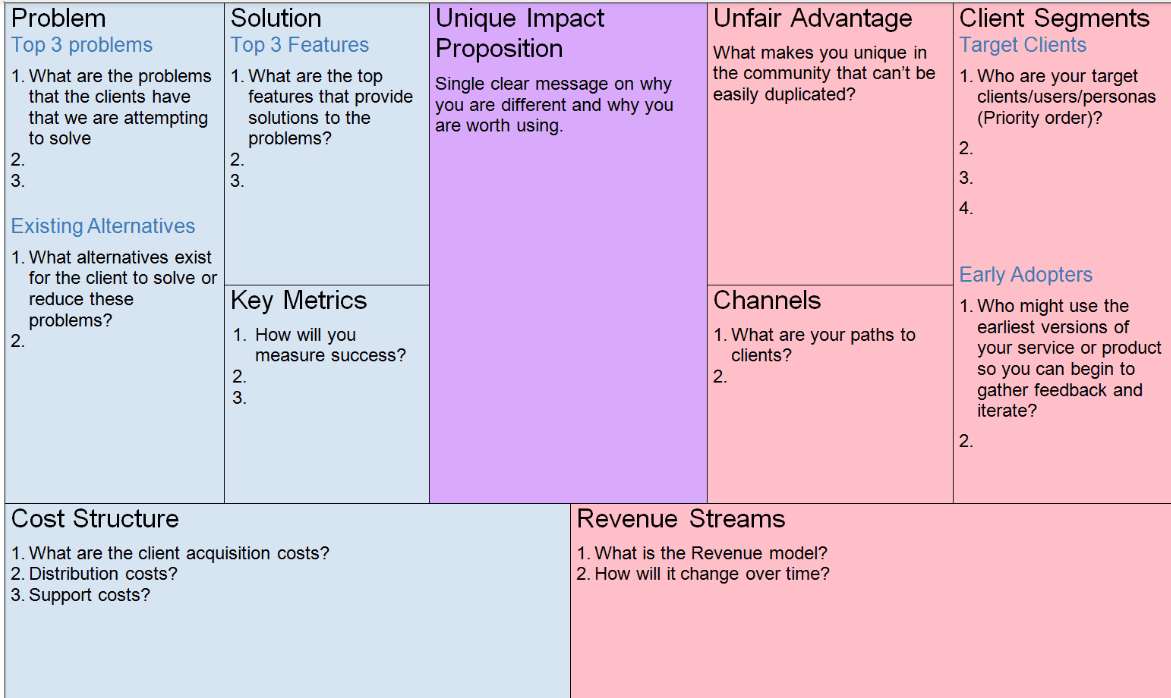
The nonprofit canvas (also commonly called a nonprofit lean canvas) is a one-page visual tool that gives stakeholders a shared perspective of:
- The product or service your organization is creating
- The market or community need that service addresses
- The unique value proposition that connects your organization’s mission to that need
Unlike a traditional strategic plan, the nonprofit canvas is meant to be filled in quickly, revisited often, and treated as a living document. It brings together program developers and stakeholders so that progress can begin and feedback can be gathered early — a core principle of the Agile and Scrum approach.
How to Fill Out Your Nonprofit Lean Canvas: 9 Steps
Below are the nine blocks of the nonprofit lean canvas and the questions that guide each one. The order below is a suggested starting point — feel free to iterate in any order as you work through the canvas.
1. Client Segments Who would benefit most from your product or service? Who would be the early adopters? Identifying your client segments first grounds everything else in the needs of real people.
2. Problem What problems do these clients have that your organization wants to address? What alternatives do they currently have — and why are those alternatives falling short? Being specific here is key to a canvas that is genuinely useful.
3. Unique Impact Proposition What is the unique impact your organization provides? What makes you different from other organizations addressing the same need? Why will clients, funders, and partners pay attention to you? This is the heart of the canvas.
4. Solution What is your solution, and what are its key features that directly address the problems you identified in block two? Keep this specific and tied back to client needs, not organizational capabilities.
5. Channels What is your path to reaching these clients? How will you communicate, deliver, and build relationships with the people you are trying to serve?
6. Revenue Streams / Funding Model How will your organization generate the income needed to sustain this product or service? This might include grants, individual donations, earned revenue, contracts, or a combination.
7. Cost Structure What will it cost to acquire clients, run your service, or create and maintain your product? Understanding your cost structure ensures your funding model is realistic.
8. Key Metrics How will you measure success? Identifying your key metrics up front keeps your team accountable and provides the data you need to iterate and improve over time.
📥 Our free Retrospective Guide is a great companion tool for reviewing your key metrics at the end of each Sprint.
9. Unfair Advantage What is your organization’s unfair advantage — the thing that makes you uniquely positioned to solve this problem in this community? This could be existing relationships, specialized expertise, a trusted reputation, or a distinctive model.
Nonprofit Canvas Example: STEM Zone
After working through these nine questions — and iterating through them a few times — here is what the completed nonprofit lean canvas looks like for our example organization, STEM Zone:

Notice how the canvas tells a coherent story across all nine blocks. The client segments, problem, and unique impact proposition align with one another — and the solution, channels, and funding model all flow from that foundation. That coherence is what makes the canvas a useful communication tool with funders, board members, and program staff.
📥 Ready to build your own? The Lean Canvas Action Guide walks you through each block with additional prompts, real examples, and a blank template. And if you’re just getting started with Agile, the Getting Started with Scrum Checklist is the perfect companion.
Bring Your Nonprofit Canvas to Your Team
A nonprofit lean canvas is most powerful when it’s built collaboratively. Getting your program staff, leadership, and even key stakeholders in the room — or the virtual room — to work through the nine blocks together creates alignment and buy-in that a top-down strategic plan rarely achieves.
📥 Our Value Facilitation Guide can help you structure that conversation around the values that matter most to your team. And if you’re working to build broader Agile adoption in your organization, the Building Buy-In for Agile Guide provides a roadmap for championing this approach with leadership.
Looking for hands-on support designing your nonprofit canvas? Contact us — we’d love to help guide your Agile transformation.
This blog was updated on 3/18/2026